
Carpal tunnel syndrome occurs when the median nerve becomes compressed as it passes through a narrow tunnel in the wrist.
Common symptoms include:
Tingling or pins and needles in the thumb, index and middle fingers
Numbness in the hand (often worse at night)
Weak grip or dropping objects
Wrist or forearm aching
Symptoms usually develop gradually and may worsen without treatment.
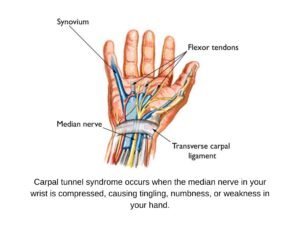
Carpal tunnel syndrome is commonly linked to:
Repetitive hand or keyboard work
Prolonged wrist bending
Pregnancy or fluid retention
Diabetes or thyroid conditions
Wrist arthritis or previous injury
Sometimes no clear cause is found.
Treatment usually starts with simple conservative care and progresses only if symptoms persist.
A wrist splint holds the wrist in a neutral position and reduces pressure on the nerve.
Typical advice
Wear at night for 4–6 weeks
Consider daytime use for aggravating tasks
Many patients notice improvement within several weeks.
Exercises help improve nerve movement and reduce stiffness.
These may include:
Gentle nerve-gliding movements
Wrist mobility exercises
Forearm stretching
Exercises should feel gentle and not sharply painful. A clinician can guide correct technique.
A corticosteroid injection can reduce inflammation inside the carpal tunnel.
When considered
Splints alone are not helping
Symptoms are moderate
Surgery is not yet required
What to expect
Quick clinic procedure
Usually performed with local anaesthetic
Improvement often begins within several days
Relief may last months, though some patients eventually require further treatment.
Hydrodisection is a newer injection approach where fluid (often containing dextrose solution) is placed around the nerve using ultrasound guidance.
Potential benefits
Separates the nerve from surrounding compressed tissues
May improve nerve movement
Can reduce symptoms without steroid exposure
This treatment may be discussed for persistent symptoms or where steroid injections are not suitable.
Helpful measures include:
Taking frequent breaks from repetitive hand tasks
Adjusting keyboard and mouse height
Avoiding prolonged wrist bending
Using ergonomic tools where possible
These steps are particularly important when work contributes to symptoms.
Surgery may be recommended if:
Numbness is constant
Thumb weakness develops
Muscle wasting occurs
Symptoms persist despite splints or injections
Nerve tests show severe compression
The procedure
A small operation releases the tight ligament over the tunnel, relieving pressure on the nerve.
Usually:
Day-case surgery
15–30 minutes
Gradual recovery over several weeks
Surgery is generally very successful, especially when performed before permanent nerve damage develops.
Seek assessment if you notice:
Constant numbness
Thumb weakness
Difficulty gripping objects
Muscle shrinking at the base of the thumb
These may indicate more advanced nerve compression.
This page is designed to help you understand your condition and treatment options. If your symptoms are not improving, a professional assessment can confirm the diagnosis and guide the safest treatment plan.
Patients looking for carpal tunnel assessment, splint advice, rehabilitation exercises, steroid injections, or hydrodisection treatment in Southampton can book an appointment with Physio Soton.
A clinician can:
Confirm whether your symptoms are truly carpal tunnel syndrome
Provide a personalised treatment plan
Advise whether an injection may help
Identify when surgical referral is appropriate
Early assessment often allows simpler treatment and faster recovery.
Carpal tunnel syndrome is caused by pressure on a wrist nerve.
Treatment typically begins with night splints and exercises, may include steroid injection or hydrodisection, and surgery is considered for persistent or severe cases.
If you would like a professional assessment, personalised exercise plan, or to discuss treatment options such as splinting, steroid injection, or hydrodisection, you can book an appointment with Physio SOton.
Appointments are available for assessment and treatment of carpal tunnel syndrome and other hand or wrist problems. Early assessment can help confirm the diagnosis and guide the most appropriate treatment for your situation.
To arrange a visit, contact Physio Soton to schedule your appointment.
Early symptoms usually include tingling, pins and needles, or numbness in the thumb, index, and middle fingers. Many people notice symptoms at night or when holding a phone, steering wheel, or keyboard for long periods.
Mild cases sometimes improve with activity changes, wrist splints, and exercises. However, if symptoms persist for several months, medical assessment is recommended to prevent long-term nerve damage.
Yes. Night splints are one of the most effective first treatments. They keep the wrist in a neutral position during sleep, reducing pressure on the nerve. Many patients notice improvement within 4–6 weeks.
Gentle nerve-gliding exercises, wrist mobility work, and forearm stretches may help reduce stiffness and improve nerve movement. Exercises should feel comfortable and not sharply painful. A clinician can guide the correct programme.
Steroid injections may be considered when splints and exercises are not enough, or when symptoms are moderate. They work by reducing inflammation and pressure around the nerve and often provide relief for several months.
Hydrodisection is an ultrasound-guided injection where fluid (often including dextrose solution) is placed around the nerve to gently separate it from surrounding tissues. This may reduce compression and improve nerve movement.
No. Many people improve with conservative treatment such as splints, exercises, or injections. Surgery is usually recommended only if symptoms are severe, long-lasting, or causing weakness or muscle loss.
Seek professional assessment if you have:
Constant numbness
Thumb weakness
Difficulty gripping objects
Muscle shrinking at the base of the thumb
These may indicate more significant nerve compression.
If you live locally and need assessment, splint advice, rehabilitation exercises, or discussion of injection options, appointments can be arranged with Physio Soton for personalised evaluation and treatment planning.
National Institute for Health and Care Excellence (NICE). Carpal Tunnel Syndrome: Assessment and Management. NG79, 2019. https://www.nice.org.uk/guidance/ng79
MacDermid JC, et al. Management of Carpal Tunnel Syndrome in Adults. British Society for Surgery of the Hand, 2020.
Gerritsen AA, et al. Treatment of carpal tunnel syndrome: a systematic review. J Hand Surg Am. 2002;27(4):652-659.
Marshall S, et al. Local corticosteroid injection for carpal tunnel syndrome. Cochrane Database Syst Rev. 2007; (2): CD001554.
Huisstede BM, et al. Non-surgical treatment for carpal tunnel syndrome. Cochrane Database Syst Rev. 2018; CD003219.
Wu YT, et al. Ultrasound-guided perineural injection of dextrose for carpal tunnel syndrome: a systematic review. Muscle Nerve. 2020;62:159–168.

Marek Czeladzki, MSc, MSK Sonographer, Independent Prescriber
Marek Czeladzki is a physiotherapist specialising in musculoskeletal (MSK) conditions, ultrasound imaging, and guided injections. He is registered with the HCPC and CSP and runs Physio Soton from Eastleigh, Southampton. He provides personalised assessment, exercise therapy, splinting, and injection treatments for conditions including carpal tunnel syndrome.
Disclaimer: This information is for educational purposes only and is not a substitute for personalised medical advice. Always consult a qualified healthcare professional regarding your individual condition.