
This page is intended for educational purposes. If you would like to book an appointment or need support with frozen shoulder, please get in touch with Physio Soton Clinic in Eastleigh, near Southampton.
Frozen shoulder, also known as adhesive capsulitis, is a painful and restrictive condition that causes progressive stiffness of the shoulder joint. It commonly affects people aged 40–60 and can significantly impact sleep, work, and everyday activities.
At Physio Soton, we provide expert assessment and treatment for frozen shoulder in Eastleigh, near Southampton, including physiotherapy, rehabilitation, and image-guided injections. For many patients, injection treatment is the most effective way forward, particularly when pain and stiffness are limiting progress.
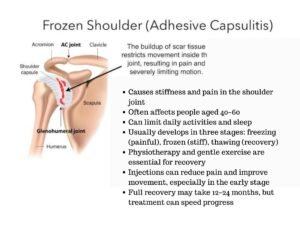
Injections are sometimes used to help manage frozen shoulder, mainly to reduce pain.
Pain relief
Steroid injections can help reduce shoulder pain, especially in the early stages.
Easier movement
Less pain can make it easier to move the shoulder and do daily activities.
Helps with physiotherapy
Pain relief may allow you to better tolerate exercises and physiotherapy treatment.
Short-term improvement
Many people feel better for weeks or months after an injection.
Not a cure
Injections do not fix frozen shoulder. The condition still takes time to improve.
Pain relief may not last
Symptoms can return once the injection wears off.
Less helpful later on
Injections work best early on. They are often less effective when stiffness is the main problem.
Possible side effects
These are uncommon but can include:
Temporary pain after the injection
Skin changes around the injection site
Infection (rare)
Blood sugar changes
In people with diabetes, injections can temporarily raise blood sugar levels.
Frozen shoulder occurs when the capsule surrounding the shoulder joint becomes inflamed, thickened, and tight, leading to:
Persistent shoulder pain
Marked stiffness
Reduced range of movement (especially lifting and rotation)
Night pain and disturbed sleep
The condition often develops gradually and typically progresses through three stages:
Painful (freezing) stage
Stiff (frozen) stage
Recovery (thawing) stage
Without appropriate treatment, frozen shoulder can last 12–24 months or longer.
For most patients, yes.
While physiotherapy plays an important role, physiotherapy alone is often ineffective when pain is severe. In frozen shoulder, pain limits movement — and movement is essential for recovery.
 Injection treatment is often the best way forward because it:
Reduces inflammation inside the joint
Relieves pain more quickly
Allows more effective physiotherapy and rehabilitation
Can shorten the overall duration of symptoms
A corticosteroid injection into the shoulder joint helps to:
Reduce inflammation
Improve pain
Increase movement
This is particularly effective in the early (painful) stage of frozen shoulder.

High volume injection (hydrodilatation) is often the most effective option for frozen shoulder.
It involves:
Injecting fluid into the shoulder joint to gently stretch the tight capsule
Reducing pain and stiffness
Improving range of movement more rapidly
At Physio Soton, high volume injection is frequently recommended for frozen shoulder and is often combined with guided rehabilitation for best results.
Your appointment includes:
A full clinical assessment of your painful shoulder
Review of symptoms, movement, and function
Discussion of treatment options
Injection treatment where appropriate
Clear advice on physiotherapy and rehabilitation following injection
All injections are performed by experienced clinicians with a strong background in musculoskeletal assessment and rehabilitation.
Injection treatment works best when combined with:
Targeted physiotherapy
Progressive shoulder exercises
Education on activity modification
Following injection, pain reduction allows you to move the shoulder more effectively, making physiotherapy significantly more beneficial.
Injection treatment may be suitable if you:
Have been diagnosed with frozen shoulder
Have significant pain or stiffness
Are struggling to progress with physiotherapy due to pain
Have night pain or sleep disturbance
A full assessment is always carried out to confirm the diagnosis and suitability.
At Physio Soton, we offer:
Expert assessment of shoulder pain
Physiotherapy and rehabilitation
Corticosteroid injections
High volume injections (hydrodilatation)
Our clinic is based in Eastleigh, conveniently located for patients from Southampton and surrounding areas.
If you are struggling with frozen shoulder and want clear guidance on whether injection treatment is the right option, we recommend a full assessment.
Book an appointment at Physio Soton to discuss the most effective treatment plan for your shoulder.
Exercise is an important part of managing frozen shoulder both before and after an injection. Gentle stretching and mobility exercises help keep the shoulder moving and prevent stiffness from worsening, and after an injection they can be started (often on the same day) to take advantage of reduced pain and improve range of motion as you recover. Exercises typically include pendulum movements, assisted range‑of‑motion stretches and shoulder blade mobility work, and should be performed regularly and without forcing painful movement. A helpful printable PDF with recommended frozen shoulder exercises can be accessed here:
 Is an injection the best treatment for frozen shoulder?
For most patients, yes.
Frozen shoulder is driven by inflammation and tightening of the joint capsule. When pain is significant, physiotherapy alone is often limited. An injection helps reduce pain and inflammation, allowing movement to improve and making physiotherapy far more effective. In many cases, injection treatment is the best way forward, particularly in the early stages.
What type of injection is best for frozen shoulder?This depends on the stage and severity of your symptoms.
Corticosteroid injections are very effective for pain relief, especially early on
High volume injections (hydrodilatation) are often the most effective option, as they help stretch the tight joint capsule and improve movement more quickly
Following assessment, we will advise which option is most suitable for you.
How long does it take for a frozen shoulder injection to work?Many patients notice:
Pain relief within a few days to two weeks
Gradual improvement in movement over the following weeks
High volume injections may provide faster improvement in range of motion, especially when combined with rehabilitation.
Will one frozen shoulder injection cure it?An injection does not “cure” frozen shoulder instantly, but it can:
Significantly reduce pain
Improve movement
Speed up recovery
Some patients improve with one injection, while others may need further treatment or ongoing physiotherapy.
Is physiotherapy still needed after a frozen shouder injection?Yes — and it is much more effective after injection.
Once pain is reduced:
Exercises are easier to perform
Movement improves more quickly
Long-term stiffness is less likely
At Physio Soton, injection treatment is combined with targeted physiotherapy and rehabilitation for the best outcome.
Is a frozen shoulder injection painful?The procedure is usually well tolerated.
You may feel brief discomfort or pressure during the injection, but this is short-lived. Any post-injection soreness typically settles within 24–48 hours.
Are corticosteroid injections safe?When used appropriately, corticosteroid injections are considered safe and effective.
Risks and side effects will be discussed during your assessment, and injections are only offered when clinically appropriate.
How long does frozen shoulder last without treatment?Frozen shoulder can last 12–24 months or longer if left untreated.
Early assessment and appropriate treatment, including injection where indicated, can reduce pain sooner and shorten recovery time.
Who should not have a frozen shoulder injection?Injection treatment may not be suitable if you:
Have an active infection
Have poorly controlled diabetes (relative consideration)
Have certain medical conditions
A full assessment is always carried out before recommending injection.
Do you offer frozen shoulder injections in Eastleigh?Yes.
At Physio Soton, we provide frozen shoulder assessment and injection treatment in Eastleigh, conveniently located for patients from Southampton and surrounding areas.
Provides a clear overview of symptoms, causes, diagnosis, and treatment.
Written in simple, patient-friendly language, tailored to UK patients.
https://www.mayoclinic.org/diseases-conditions/frozen-shoulder/diagnosis-treatment/drc-20372690
Offers detailed information on treatment options, exercises, and recovery stages.
Good diagrams and patient guidance.
Focused on physiotherapy and rehabilitation exercises.
Step-by-step guidance for improving shoulder movement.
https://orthoinfo.aaos.org/en/diseases–conditions/frozen-shoulder-adhesive-capsulitis
Evidence-based guidance on frozen shoulder, including injections, physiotherapy, and surgery.
Suitable for patients wanting more detailed information.
Many NHS Trusts provide downloadable exercise guides for frozen shoulder.
Example: Royal Berkshire NHS – Frozen Shoulder Exercise Leaflet
These provide illustrated exercises to improve movement safely at home.
Read the NHS or Mayo Clinic guides first for a general understanding.
Follow exercises only as recommended by your clinician.
Use these resources alongside professional care at Physio Soton in Eastleigh, where we provide full assessment, physiotherapy, rehabilitation, and injection treatment.
 Marek Czeladzki is a highly experienced physiotherapist, musculoskeletal sonographer, and injection specialist based in Hampshire. He uses diagnostic ultrasound to assess joint and soft tissue conditions and provides ultrasound-guided injections to support pain relief and recovery. Marek works closely with patients and the wider clinical team to deliver safe, accurate, and evidence-based care.